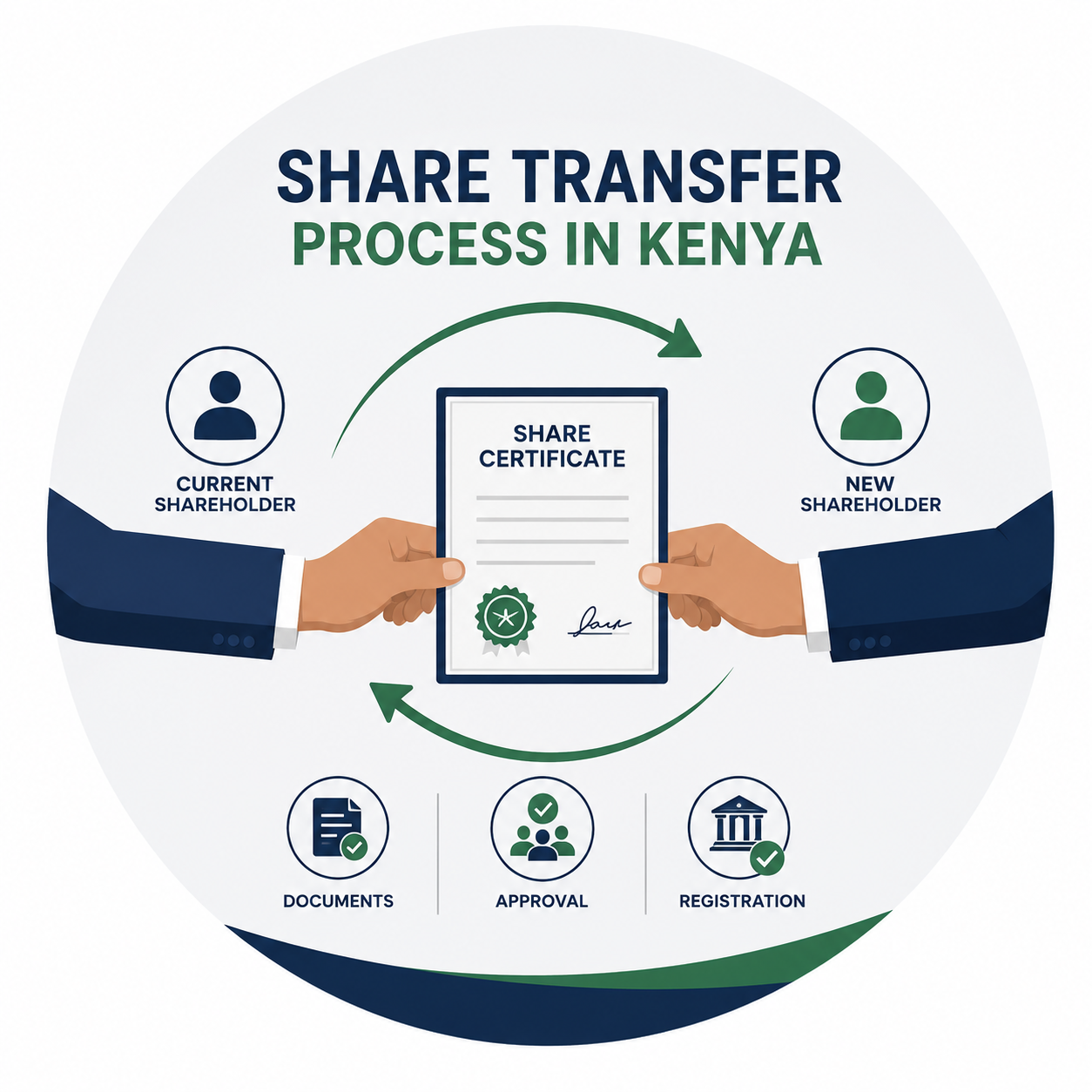
Share Transfer Process in Kenya: Step-by-Step Guide (2026)
Introduction
The share transfer process in Kenya allows existing shareholders to transfer ownership of their shares to another individual or corporate entity without creating new shares. Whether you are restructuring your company, bringing in a new investor, exiting a business, or transferring shares to family members or business partners, it is essential to follow the correct legal procedure to ensure the transfer is valid and properly recorded.
The share transfer process in Kenya is primarily governed by the Companies Act, 2015, the company’s Articles of Association, the Stamp Duty Act, and any applicable shareholders’ agreement. While the process is generally straightforward, failing to comply with these legal requirements can result in delays, disputes among shareholders, or non-compliance with statutory obligations.
If you are acquiring shares in a newly incorporated company, we recommend first reading our Company Registration in Kenyaguide, which explains the incorporation process, company structures, and post-registration compliance requirements. Likewise, if the share transfer results in a change of ownership, you may also need to update the company’s Beneficial Ownership Register to comply with Kenyan law.
In this guide, we explain the share transfer process in Kenya, the applicable laws, required documents, legal considerations, and the step-by-step procedure to help you complete a compliant share transfer.
What is a Share Transfer?
A share transfer is the legal transfer of ownership of existing shares from one shareholder (the transferor) to another person or entity (the transferee).
Unlike the allotment of new shares, a share transfer does not increase the company’s share capital. Instead, it simply changes who owns the existing shares.
For example:
A shareholder may sell all or part of their shares to another investor.
A business owner may transfer shares to a family member as part of succession planning.
An investor may dispose of shares after exiting the company.
A foreign investor may acquire shares in an existing Kenyan company instead of registering a new company.
Once the transfer is completed, the new shareholder acquires the rights attached to those shares, including voting rights, dividend entitlements, and any other rights provided under the company’s Articles of Association.
Laws Governing the Share Transfer Process in Kenya
Several laws regulate the share transfer process in Kenya, ensuring that transfers are conducted fairly and transparently.
The key legal framework includes:
The Companies Act, 2015 – Governs the transfer of shares, maintenance of the register of members, and shareholders’ rights.
The Companies (General) Regulations – Provide procedural requirements relating to company records and share transfers.
The Stamp Duty Act – Regulates stamp duty payable on certain share transfer transactions.
The Company’s Articles of Association – May contain restrictions or procedures for transferring shares.
Shareholders’ Agreement – Where applicable, this may impose additional obligations such as pre-emptive rights or approval requirements.
Understanding these legal requirements is essential before commencing the share transfer process in Kenya.
Can Shares Be Freely Transferred in Kenya?
The answer depends on the type of company.
Public Companies
For public companies, shares are generally freely transferable unless restricted by law.
Private Companies
For private companies, the share transfer process in Kenya is often subject to restrictions contained in the company’s Articles of Association.
Common restrictions include:
Existing shareholders having the first right of refusal before shares are offered to an external party.
Requiring approval from the Board of Directors before the transfer is registered.
Restrictions on transferring shares to competitors or unrelated third parties.
Compliance with any valuation method agreed upon by the shareholders.
Before beginning any share transfer, it is therefore important to review the company’s constitutional documents and any shareholders’ agreement.
Why Understanding the Share Transfer Process in Kenya is Important
Following the correct share transfer process in Kenya protects both the transferor and the transferee while ensuring the company remains compliant with Kenyan company law.
A properly executed share transfer helps to:
Ensure the new shareholder is legally recognised.
Prevent ownership disputes.
Maintain accurate statutory registers.
Facilitate investment and business restructuring.
Demonstrate corporate compliance during audits, due diligence, or fundraising.
Protect shareholders’ rights under the Companies Act, 2015.
Step-by-Step Share Transfer Process in Kenya
Understanding the share transfer process in Kenya is essential to ensure the transfer is legally valid and properly recorded. While the exact procedure may vary depending on the company’s Articles of Association, the following steps generally apply to most private companies in Kenya.
Step 1: Review the Company’s Articles of Association
Before initiating the share transfer process in Kenya, review the company’s Articles of Association and any shareholders’ agreement.
This is important because these documents may contain restrictions on transferring shares, including:
Whether the Board of Directors must approve the transfer.
Whether existing shareholders have the first right to purchase the shares (pre-emptive rights).
Whether there are restrictions on transferring shares to third parties.
The procedure for determining the value of the shares.
Ignoring these provisions may result in the transfer being rejected or challenged by other shareholders.
Step 2: Agree on the Terms of the Share Transfer
Once the restrictions have been reviewed, the transferor and transferee should agree on:
The number of shares being transferred.
The purchase price (if applicable).
The payment terms.
The proposed transfer date.
Any warranties or conditions relating to the transfer.
For significant transactions, it is advisable to prepare a Share Purchase Agreement (SPA) to clearly outline the rights and obligations of both parties.
Step 3: Obtain Board Approval (Where Required)
Many private companies require the Board of Directors to approve a share transfer before it can be registered.
During the meeting, the Board may:
Approve the transfer of shares.
Approve the registration of the new shareholder.
Authorise the cancellation of the existing share certificate.
Approve the issuance of a new share certificate.
The approval should be documented through a Board Resolution and kept with the company’s statutory records.
Step 4: Complete the Share Transfer Form
The next step in the share transfer process in Kenya is completing and signing the Instrument of Transfer (Share Transfer Form).
The form typically includes:
Company name.
Name and address of the transferor.
Name and address of the transferee.
Number and class of shares.
Consideration paid (if any).
Date of transfer.
Signatures of the parties.
Ensure all details are accurate to avoid delays in registering the transfer.
Step 5: Assess and Pay Stamp Duty (Where Applicable)
Certain share transfers are subject to Stamp Duty. The Instrument of Transfer should be assessed to determine whether duty is payable before the transfer is registered.
The amount payable depends on the value of the transaction and the applicable provisions of the Stamp Duty Act.
Where an exemption applies, supporting documentation should be retained for future reference.
Step 6: Update the Company’s Register of Members
Once the transfer has been approved and all legal requirements have been met, the company should update its Register of Members.
This involves:
Removing or reducing the transferor’s shareholding.
Recording the transferee as the new shareholder.
Updating the number of shares held by each shareholder.
A person only becomes the legal shareholder once their name has been entered in the Register of Members.
Step 7: Issue a New Share Certificate
After updating the register, the company should:
Cancel the old share certificate (where appropriate).
Issue a new share certificate to the transferee.
The share certificate serves as evidence of ownership and should be kept safely with the company’s records.
Documents Required for the Share Transfer Process in Kenya
The following documents are commonly required:
Document
Purpose
Share Transfer Form (Instrument of Transfer)
Records the transfer of shares
Share Purchase Agreement (where applicable)
Sets out the agreed commercial terms
Board Resolution
Approves the transfer
Original Share Certificate
Evidence of existing ownership
Updated Register of Members
Records the new shareholder
New Share Certificate
Confirms ownership after the transfer
Stamp Duty Assessment/Payment (where applicable)
Demonstrates compliance with tax requirements
How Long Does the Share Transfer Process in Kenya Take?
The timeline depends on the company’s internal approval process and the completion of any applicable stamp duty requirements.
In most cases, the share transfer process in Kenya can be completed within 5 to 14 working days, provided all required documents are available and there are no disputes or restrictions under the company’s Articles of Association.
Can a Foreigner Transfer or Acquire Shares in a Kenyan Company?
Yes. A foreign individual or foreign company may acquire or transfer shares in a Kenyan company, subject to the Companies Act, 2015, the company’s Articles of Association, and any sector-specific laws that restrict foreign ownership.
For example, certain regulated sectors such as telecommunications, insurance, aviation, and media may have foreign ownership limitations. Before acquiring shares, it is advisable to confirm whether the target company operates in a regulated industry.
Foreign investors should also ensure that any changes in beneficial ownership are recorded where required by law.
Common Mistakes to Avoid During the Share Transfer Process in Kenya
Although the share transfer process in Kenya is relatively straightforward, businesses often make mistakes that lead to delays or disputes.
Some of the most common mistakes include:
Failing to review the Articles of Association before initiating the transfer.
Ignoring pre-emptive rights of existing shareholders.
Failing to obtain the necessary Board approval.
Not assessing or paying stamp duty where applicable.
Failing to update the Register of Members.
Delaying the issuance of a new share certificate.
Overlooking beneficial ownership reporting obligations where applicable.
Seeking professional legal or corporate secretarial assistance can help ensure that the transaction is completed correctly and in compliance with Kenyan law.
Frequently Asked Questions
1. What is the share transfer process in Kenya?
The share transfer process in Kenya involves reviewing the company’s Articles of Association, obtaining any required approvals, completing a share transfer form, paying stamp duty where applicable, updating the Register of Members, and issuing a new share certificate.
2. How long does the share transfer process take?
In most cases, the process takes 5 to 14 working days, depending on the company’s internal procedures and the completion of any stamp duty requirements.
3. Is Board approval required for a share transfer?
It depends on the company’s Articles of Association. Many private companies require Board approval before a transfer can be registered.
4. Is stamp duty payable on every share transfer?
Not always. Whether stamp duty is payable depends on the nature and value of the transaction and the applicable provisions of the Stamp Duty Act.
5. Can a foreigner own shares in a Kenyan company?
Yes. Foreign individuals and foreign companies can generally own shares in Kenyan companies, subject to any sector-specific restrictions.
6. Does a share transfer change the company’s share capital?
No. A share transfer only changes ownership of existing shares. It does not create new shares or increase the company’s share capital.
7. Can shares be transferred to a family member?
Yes. Shares may be transferred to a family member, provided the company’s Articles of Association and all applicable legal requirements are complied with.
8. Is a Share Purchase Agreement mandatory?
Not in every case. However, it is highly recommended, particularly where shares are being sold for valuable consideration or where the transaction is complex.
9. What documents are required for a share transfer?
Common documents include the Share Transfer Form, Board Resolution (where required), Share Purchase Agreement (if applicable), original share certificate, updated Register of Members, and any stamp duty documentation.
10. Who updates the Register of Members?
The company, usually through its directors or company secretary, is responsible for updating the Register of Members after the transfer has been approved.
Conclusion
The share transfer process in Kenya is an important corporate procedure that enables businesses to restructure ownership, admit new investors, or facilitate shareholder exits while maintaining legal compliance. By following the requirements of the Companies Act, 2015, complying with the company’s Articles of Association, and ensuring that all statutory records are updated, businesses can complete share transfers efficiently and minimise the risk of future disputes.
Whether you are transferring shares as part of an investment, succession plan, or business restructuring, seeking professional guidance can help ensure the process is completed accurately and in accordance with Kenyan law.
Simplify the Share Transfer Process in Kenya with AfriLink Consultants
Transferring shares involves more than signing documents-it requires compliance with corporate and statutory requirements. At AfriLink Consultants, we assist local and foreign investors with every stage of the share transfer process in Kenya, including document preparation, corporate secretarial services, regulatory compliance, and updating statutory registers.
Whether you are restructuring your company, bringing in a new shareholder, or exiting a business, our team is ready to help.
We assist you in selecting the optimal business structure, handle all registration procedures with government authorities
01
Work Permit & Visa Facilitation
Our team streamlines the work permit and visa application process for you and your employees
02
Tax Compliance & Advisory
We guide you through the tax framework, advise on tax optimization strategies, and prepare all necessary tax filings
03
Office Sourcing:
Don't waste time searching for the ideal office space. We leverage our local expertise to find the perfect location that meets your needs and budget
04
Licensing
Afrilink understands navigating these licensing requirements can be complex. That's where we come in!
05
Virtual Assistance
Focus on your core business while we handle the administrative burden. Our vetted virtual assistants provide a range of services,
06
Company Search
Finding the right local partner can be crucial for your East African success. We utilize our extensive network and resources
07
Trademark Registration
Protect your brand identity and intellectual property in East Africa. We guide you through the trademark registration process, ensuring your brand is legally recognized
08
SEZ and EPZ Solutions
Unlock the benefits of Special Economic Zones (SEZs) and Export Processing Zones (EPZs).
09
Charities and NGO Support
We are passionate about supporting organizations making a positive social impact in East Africa.